
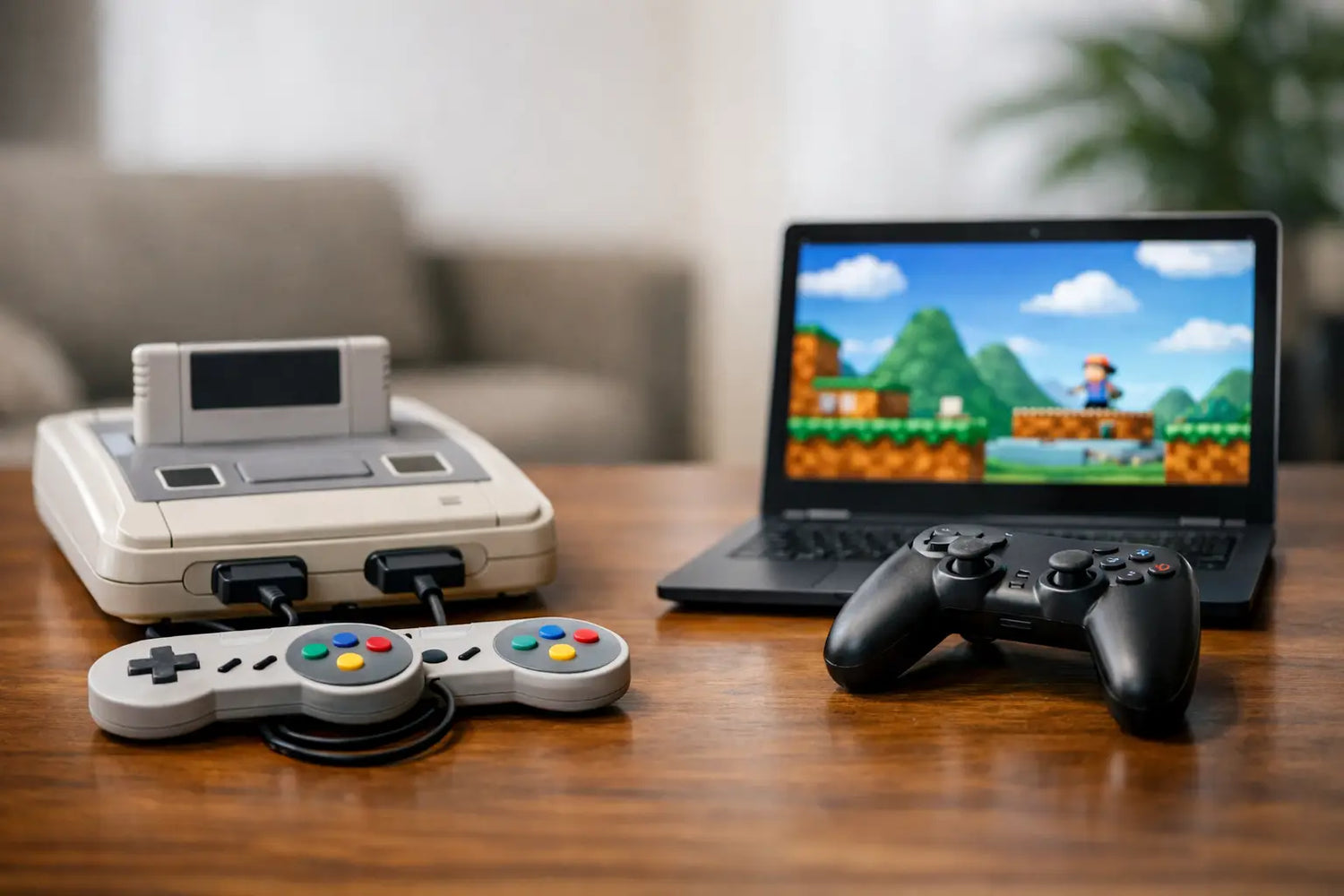
That old-school startup sound still hits. So does the urge to replay your childhood favorites without spending your weekend fighting cables, mystery adapters, and menus from 1998. That is where the retro console vs emulator debate gets real. One gives you the original hardware feel, the other gives you convenience and flexibility, and both can be the right pick depending on how you actually want to play.
If you are shopping for a fun gaming setup, this choice matters more than people think. Some players want the exact click of an original controller and the tiny quirks of old hardware. Others just want to press start, save anywhere, and enjoy a huge library without turning their TV stand into a museum. Neither side is wrong. You just need to know what you are paying for.
Retro console vs emulator: the real difference
A retro console is the physical hardware, whether that means an original system or a modern plug-and-play device built to recreate a classic experience. An emulator is software that mimics that hardware on another device like a PC, handheld, phone, tablet, or mini gaming box.
That sounds simple, but the experience is very different. A retro console feels more tactile and specific. You are using dedicated hardware, often with period-correct controllers, and sometimes even original cartridges or discs. An emulator is more flexible. It can store multiple systems in one place, add visual filters, improve load times, and let you jump between games in seconds.
The question is less about which option is objectively better and more about what kind of fun you want. Authenticity has a cost. Convenience has trade-offs. Your best choice depends on whether you care more about the original feel or the easiest way to play.
Why a retro console still has serious appeal
There is a reason original hardware keeps pulling people back. A real retro console gives you the closest thing to the experience players had when those games first came out. The controller shape, the boot screen, even the tiny hardware imperfections all add character. For a lot of people, that is not nostalgia talking. It is part of the game.
Original hardware also removes one layer of abstraction. You are not asking software to imitate a machine. You are using the machine, or something built specifically to reproduce it. That can matter for input feel, audio behavior, and compatibility with accessories. If you want to collect, display, or share games in a way that feels physical and personal, a console setup simply has more presence.
There is also a social side to it. A retro console in the living room invites people in. Hand someone a controller, hear them say, "Wait, I remember this level," and suddenly the room is doing half the work. It feels less like opening an app and more like starting an event.
The downside is obvious. Real hardware can get expensive fast, especially if you want clean, working units, original controllers, and games that are no longer cheap. Setup can also be messy. Older systems were not designed for modern TVs, and that can mean adapters, scaling issues, and extra troubleshooting before the fun starts.
Where emulators make life easier
Emulators win hard on flexibility. You can keep a huge library in one place, switch systems without swapping hardware, and use features older consoles never had. Save states alone are enough to convert a lot of players. If you have ever replayed a brutally difficult game from the 8-bit or 16-bit era, the ability to save anywhere feels less like cheating and more like basic self-care.
Emulators also lower the barrier to entry. Instead of buying multiple aging systems, you can often use one device for many generations of games. That makes them appealing for casual players, budget shoppers, travelers, and anyone who wants retro gaming without building a shelf full of equipment.
Visual options are another plus. Some players love scanline filters and original aspect ratios. Others want cleaner image scaling on modern screens. Emulators usually let you choose. You can tune the look to match your nostalgia level, from "make it feel like 1994" to "make this playable on a 4K TV without my eyes filing a complaint."
Still, ease comes with caveats. Emulator quality varies. Some games run beautifully, while others have odd audio, timing issues, or compatibility quirks. The setup can also be more technical than expected, especially if you are trying to organize files, map controllers, and get everything running cleanly across different systems.
The biggest trade-offs most buyers care about
Price is usually the first factor. If you want to play across multiple classic systems, emulation is almost always cheaper. You are not hunting down separate hardware, replacement parts, or collector-priced games. For someone who wants maximum variety for minimum cost, the value is hard to ignore.
But if your goal is collecting, displaying, or recreating a specific era, a retro console offers a different kind of value. It is not just about gameplay. It is about ownership, nostalgia, and the experience of using something real. That can feel more satisfying than loading files onto a device, even if it costs more.
Convenience is the next big split. Emulators are faster to access once they are set up properly. You can browse, launch, save, and switch games with almost no friction. Retro consoles ask more from you. They take up space, need accessories, and often require more effort to keep in working condition.
Then there is accuracy. Purists usually lean console because original hardware avoids the little mismatches that can happen in software emulation. But for many players, those differences are tiny compared with the convenience benefits. If your main goal is to enjoy the game, not measure frame timing with a microscope, a good emulator may feel more than good enough.
Retro console vs emulator for casual players
If you just want to play classic games after work, on weekends, or during a nostalgia kick, the answer is usually simple. Go with the option that gets you playing fastest. For most people, that means an emulator-based device or a modern retro gaming unit that keeps setup light and the game library accessible.
That is especially true if you are buying for a gift, a dorm room, a small apartment, or a family setup where nobody wants a full technical project. Convenience matters. Being able to plug in, pick a game, and start playing beats spending two evenings figuring out why an old console looks weird on your TV.
On the other hand, if one specific system means everything to you, the retro console route starts making more sense. Maybe it is the exact controller you grew up with. Maybe it is the cartridge ritual. Maybe you want the shelf appeal too. If the hardware itself is part of the joy, emulation will not fully replace it.
What about legality and ownership?
This is where people get vague, fast. Emulators themselves are not the issue. The legal questions usually involve game files, BIOS files, and whether you own the original software you are playing. Rules can vary by region and by how content is obtained.
The smart move is simple. Be careful, know the rules that apply to your setup, and avoid treating emulation like a free-for-all. If you want a low-stress experience, buying a legitimate retro gaming device or physical console can feel cleaner and easier than navigating gray areas.
Which one should you actually choose?
Choose a retro console if you care most about authenticity, physical ownership, collecting, or recreating the original experience as closely as possible. It is the better fit for dedicated fans who love the hardware as much as the games.
Choose an emulator if you care most about affordability, convenience, portability, and having more games in less space. It is ideal for players who want instant access, modern features, and a setup that works with current screens and devices.
There is also a middle ground, and honestly, that is where a lot of people land. You might keep one favorite retro console for the emotional heavy hitters and use emulator-based devices for everything else. That combo gives you the best of both worlds without turning your gaming budget into a side quest.
At Timo Market, that is the sweet spot a lot of shoppers are after - fun that feels exciting right away, without making the buying decision harder than the game itself. If your goal is to press start and enjoy the moment, pick the setup that matches your habits, not somebody else’s nostalgia rules.
The best retro gaming choice is the one that keeps you playing. If that means original hardware, go all in and enjoy the real thing. If that means fast setup, flexible libraries, and modern convenience, that is a win too. The good news is you do not need permission from the internet to enjoy old games your way.




Commenta
Questo sito è protetto da hCaptcha e applica le Norme sulla privacy e i Termini di servizio di hCaptcha.