
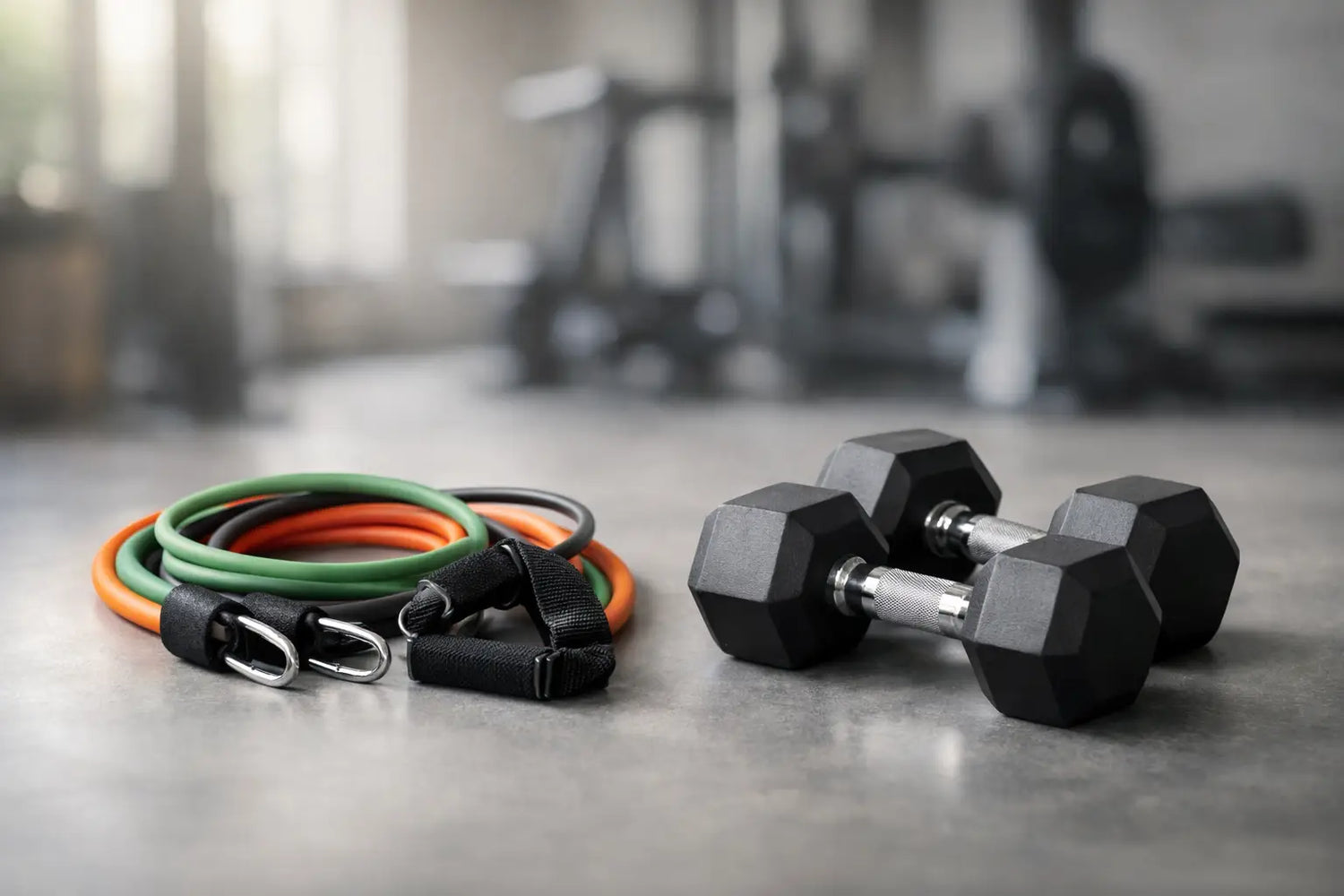
You do not need a garage full of gear to get stronger. For most home workouts, the real question is simpler: resistance bands vs dumbbells. One takes up almost no space and travels easily. The other feels classic, straightforward, and easier to load with serious weight. If you are building a home gym without wasting money or square footage, this choice matters.
Resistance bands vs dumbbells: the real difference
At a glance, both tools create resistance so your muscles have to work. That part is obvious. The less obvious part is how they feel through a movement, how easy they are to progress with, and how well they fit your routine when motivation is high one week and hanging by a thread the next.
Dumbbells provide consistent external load. If you pick up a 20-pound dumbbell, it is 20 pounds from start to finish. That makes them simple to understand and easy to track. You know what you lifted, how many reps you did, and whether you are improving.
Resistance bands work differently. Tension usually increases as the band stretches, so the movement often feels lighter at the beginning and harder near the end. That changing resistance can be great for certain exercises, but it also means bands do not feel exactly like free weights. Not better, not worse - just different.
If you want the quick version, dumbbells are usually better for straightforward strength progression, while bands are often better for convenience, versatility, and joint-friendly training at home or on the go.
When dumbbells make more sense
If your main goal is building strength in a clear, measurable way, dumbbells are hard to beat. They make basic movements feel natural: presses, rows, goblet squats, lunges, curls, Romanian deadlifts. There is less setup, less guesswork, and usually less fiddling around with door anchors and foot placement.
They also help with progressive overload in a very simple way. You go from 15 pounds to 20. Then 20 to 25. That kind of clean progression is useful if you like seeing proof that your workouts are paying off.
Dumbbells also tend to feel more stable for beginners learning movement patterns. A chest press with dumbbells is often easier to understand than trying to keep a resistance band positioned correctly behind your back. If you are the kind of person who wants gear that works immediately and does not need a mini engineering session before every set, dumbbells have an edge.
The trade-off is obvious. They cost more, take up more room, and get heavy fast - not just in your hands, but in your apartment, your closet, and your shipping box.
When resistance bands are the smarter buy
Bands are the low-drama option for small-space workouts. You can fold them into a drawer, toss them into a suitcase, and set up a decent full-body session in a bedroom, office, or hotel room. If your home gym has to share space with your bed, desk, or actual life, bands are incredibly practical.
They are also usually more affordable. For the price of one pair of mid-weight dumbbells, you can often get a full set of bands with multiple resistance levels. That gives you more exercise variety without turning your place into a fitness warehouse.
Bands can also be gentler on joints for some people. Because the resistance increases as the band stretches, certain movements feel smoother and less jarring at the start. That can be helpful for shoulder work, glute activation, rehab-style training, and high-rep workouts where control matters more than max load.
And yes, bands can absolutely make you sweat. A well-designed band workout can humble you very quickly, especially with slower tempo, pauses, and shorter rest periods. Do not let the lightweight look fool you. Bands have a sneaky way of turning simple moves into why-are-my-legs-shaking moments.
Strength gains: which one builds more muscle?
This is where people usually want a dramatic answer. Sorry - it depends.
You can build muscle with both resistance bands and dumbbells, especially if you train consistently, push close to fatigue, and increase difficulty over time. For beginners and intermediate home exercisers, both can be effective.
That said, dumbbells usually offer a higher ceiling for long-term strength development. It is easier to load heavier compound movements, easier to standardize your training, and easier to keep progressing once your body adapts. If your goal is to get significantly stronger over time, dumbbells make that path more direct.
Bands still hold up well for muscle endurance, accessory work, and surprisingly challenging hypertrophy sessions. They are especially useful for lateral raises, kickbacks, rows, chest fly variations, and glute-focused exercises. But as you get stronger, some lower-body moves can become awkward to load heavily with bands alone.
So if your goal is general fitness, muscle tone, convenience, and regular workouts you will actually stick with, bands can be enough. If your goal is maximizing strength and having more room to level up, dumbbells usually win.
Space, budget, and everyday convenience
This is where resistance bands often make dumbbells sweat a little.
A set of dumbbells can be fantastic, but it is not exactly subtle. Even adjustable dumbbells save space compared to a full rack, yet they still need a home. Bands, on the other hand, basically disappear when you are done.
Budget matters too. A starter setup with bands is usually easier on your wallet, especially if you are not sure how committed you are yet. That makes bands a smart first step for anyone who wants to start training now instead of waiting until they can justify a bigger purchase.
There is also the friction factor. If your equipment is easy to grab, you are more likely to use it. A band workout that actually happens beats a dumbbell workout you keep postponing because your space feels cramped or your setup feels annoying.
For shoppers building a compact home workout setup, this is where curated gear matters. The best fitness products are not just effective on paper. They fit real homes, real schedules, and real attention spans.
Which is better for beginners?
Beginners can do well with either tool, but the best choice depends on personality as much as fitness level.
If you like simple, obvious, and easy-to-measure, dumbbells are often more beginner-friendly. Pick them up, perform the movement, and track the weight. Clean and easy.
If you want low cost, low space commitment, and more flexibility, resistance bands are often the better first buy. They lower the barrier to entry, which is a big deal when you are trying to build a habit. Starting small is still starting.
One caveat: bands can be a little trickier to learn at first. Anchor points, body positioning, and tension setup matter. Once you get the hang of them, they are extremely useful. But the first workout may involve a bit more trial and error than dumbbells.
The best choice by workout goal
If your workouts are centered on strength, progressive overload, and classic resistance training, dumbbells deserve the spotlight. They shine in structured programs and are usually the better tool for people who want tangible strength milestones.
If your workouts need to be flexible, portable, and apartment-friendly, resistance bands make a strong case. They are excellent for quick circuits, full-body sessions, mobility work, and staying consistent when life gets chaotic.
If fat loss is your main goal, neither tool is magic on its own. The better option is the one you will use consistently while keeping your overall activity and nutrition in check. A pair of dumbbells collecting dust does not beat bands that show up for four workouts a week.
For recovery, warm-ups, and accessory training, bands often have the advantage. For heavy lower-body work and straightforward upper-body strength training, dumbbells usually come out ahead.
So, should you buy resistance bands or dumbbells?
If you can only choose one, think less about what looks more serious and more about what fits your life. Dumbbells are excellent for building strength with simple progression. Resistance bands are excellent for affordable, compact, flexible training you can do almost anywhere.
For a lot of people, the smartest setup is not resistance bands vs dumbbells as an either-or battle. It is starting with the tool you will use now, then adding the other later. Bands can fill gaps dumbbells miss. Dumbbells can add load bands cannot match as easily. Together, they create a more versatile home gym without going overboard.
If your budget is tight, start with bands. If your priority is measurable strength progress, start with dumbbells. If you want the best of both worlds, build gradually and keep it practical.
The right gear is the gear that makes you train again tomorrow, not the gear that looks impressive in a product photo. Choose the option that fits your space, your goals, and your actual routine - then put it to work.




Commenta
Questo sito è protetto da hCaptcha e applica le Norme sulla privacy e i Termini di servizio di hCaptcha.