
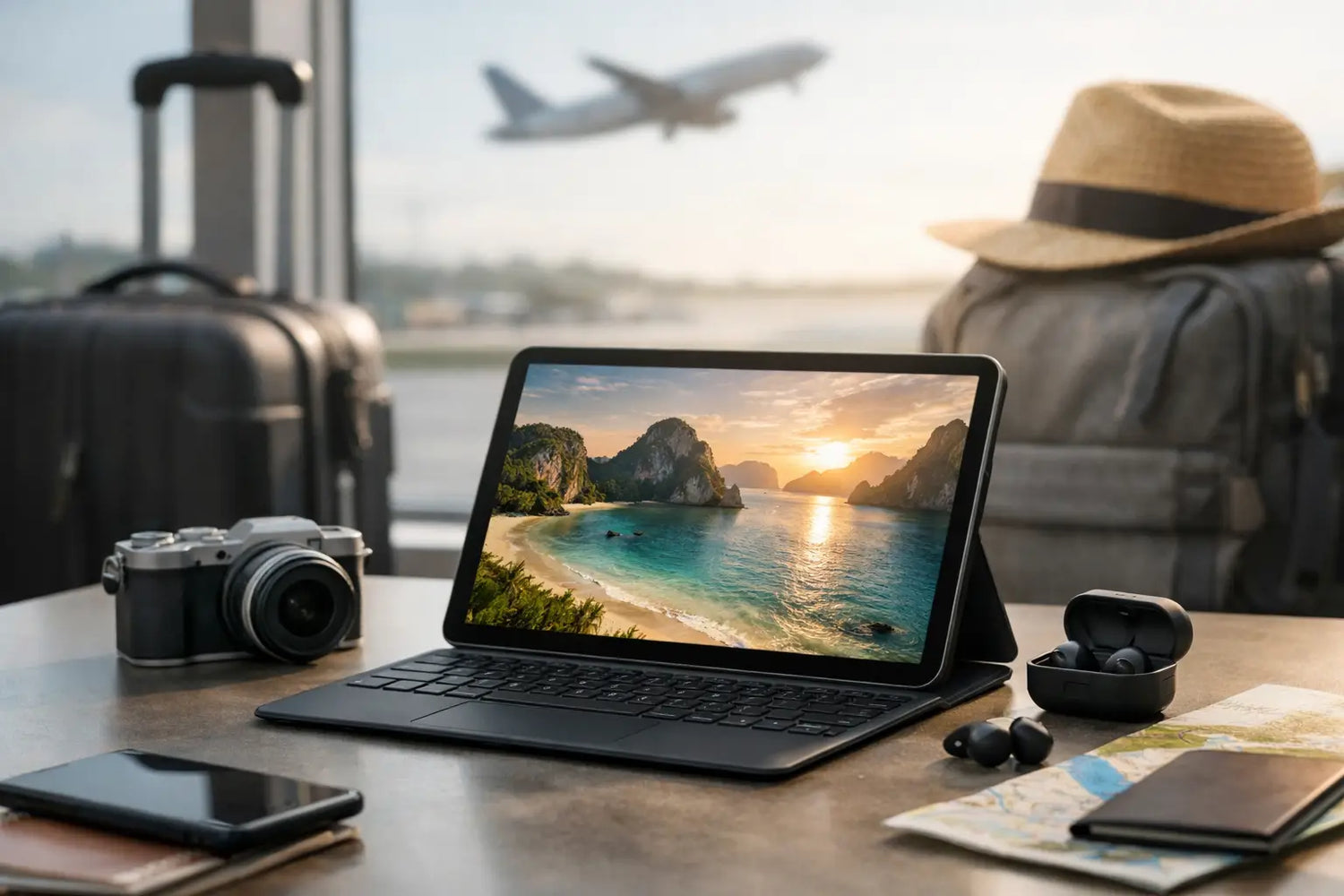
Airport gate, 12% phone battery, laptop too bulky to pull out, and your boarding group still hasn’t been called. That’s the exact moment a portable tablet for travel stops feeling like a nice extra and starts feeling like the smartest thing in your bag. A good travel tablet gives you entertainment, maps, work backups, video calls, reading, and light productivity without turning your carry-on into a brick.
The trick is not buying the biggest screen or the flashiest specs. Travel changes the rules. You want something light enough to hold one-handed, strong enough to survive constant packing, and efficient enough to last through delays, layovers, and long rides when outlets are nowhere in sight. If a device is amazing at home but annoying at 30,000 feet, it’s the wrong pick.
What makes a portable tablet for travel worth packing?
Portability sounds obvious, but it means more than screen size. A travel-friendly tablet should disappear into your routine. It should slide into a backpack pocket, fit on a tiny tray table, and feel comfortable during a long binge-watch session or a quick hotel check-in. Weight matters just as much as dimensions, especially if you’re already carrying chargers, headphones, a power bank, and the random snacks you swore you wouldn’t buy at the airport.
Battery life is another deal-breaker. Brands love quoting all-day battery numbers, but travel is messy. Brightness gets pushed up in sunny terminals, Wi-Fi and Bluetooth stay active, and downloaded movies become a survival tool. Real-world battery performance matters more than the marketing headline. For most travelers, a tablet that comfortably handles 8 to 10 hours of mixed use is the sweet spot.
Durability also deserves more attention than it gets. Travel bags are chaos. Tablets get packed next to keys, shoved under airplane seats, and balanced on café tables that wobble like they’re testing your patience on purpose. An aluminum body, sturdy case support, and reliable screen protection go a long way.
Size matters - but not in the way you think
A lot of shoppers assume bigger is better because larger displays feel more immersive. Sometimes that’s true. If your main goal is watching movies, editing documents, or using split-screen apps, a larger tablet can feel much more comfortable. But there’s a trade-off. Bigger tablets are harder to hold for long periods, less convenient in crowded spaces, and more awkward to pack.
For most people, the best portable tablet for travel lands in the small-to-mid-size range. Around 8 to 11 inches gives you a nice balance between screen space and actual portability. Smaller tablets feel easier for reading, maps, and handheld use. Mid-size models feel better for typing, streaming, and multitasking. There’s no universal winner here - it depends on whether your travel style leans more minimalist or more productivity-focused.
If you fly often, think about tray tables and seat space. If you commute, think about one-handed use. If you road-trip, think about how the screen looks in changing light and whether passengers will share it.
The features that actually matter on the road
Storage is one of those specs people ignore until they’re trying to download shows in an airport with bad Wi-Fi. If you travel often, local storage matters. Streaming is great until it isn’t. Downloaded movies, music, offline maps, travel documents, and photos add up fast. If your tablet supports expandable storage, that’s a real advantage.
Connectivity matters too. Wi-Fi-only tablets are usually more affordable, and for plenty of people, that’s enough. Hotel Wi-Fi, airport hotspots, and phone tethering can cover a lot. But if you work remotely or move around constantly, cellular support can make life much easier. It costs more, yes, but convenience has value when your connection is your schedule.
Camera quality usually isn’t the reason to buy a tablet, but front-facing camera performance matters more than rear-camera specs for travel. A clean video call with family, a work check-in from a hotel room, or a quick virtual meeting from a quiet café is far more useful than trying to replace your phone camera with a tablet the size of a cutting board.
Then there’s charging. Fast charging is a huge bonus. USB-C is even better because it simplifies your setup. Fewer cable types means less clutter, less packing stress, and fewer moments of digging through your bag like you’re on a game show.
Choosing a portable tablet for travel by use case
Not every traveler needs the same machine. That’s where people overspend. They buy for possibilities instead of patterns.
If your travel is mostly entertainment-focused, prioritize screen quality, speakers, storage, and battery life. You want something that makes movies, games, reading, and browsing feel good without costing laptop money. A sharp display and decent audio can completely change the experience during delays or long evenings in a hotel.
If you travel for work, look harder at keyboard support, multitasking, app compatibility, and cloud syncing. A tablet can absolutely handle email, calls, notes, presentations, and basic document edits, but some are much better at light productivity than others. The wrong software setup can turn a simple task into a tiny travel meltdown.
If you want one device for everything, balance matters most. Don’t chase the highest-end option automatically. The best all-around travel tablet is usually the one that is easy to carry, reliable for media, and capable enough for quick tasks without needing a backpack full of accessories.
Accessories can make or break the experience
A tablet alone is only part of the setup. The right extras turn it from “nice gadget” into “why didn’t I bring this sooner?”
A slim case is almost mandatory. It protects your device and often doubles as a stand, which is perfect for flights, trains, and hotel nightstands. A detachable keyboard is great if you write often, but it adds bulk, so it’s only worth it if you’ll actually use it. The same goes for a stylus. Amazing for note-taking, sketching, and editing - unnecessary if your tablet is mostly for streaming and browsing.
Noise-canceling earbuds or headphones pair especially well with a travel tablet. Bigger screen, better audio, less chaos. That’s a solid upgrade for planes alone. A compact power bank is also smart, especially if your tablet supports efficient charging and you don’t want to fight for wall outlets at the gate.
Common mistakes shoppers make
The biggest one is buying too large. A tablet can look sleek online and still feel annoying after a full day of carrying it around. If portability is the goal, be honest about how much screen you really need.
The second mistake is underestimating battery life. Travel days are rarely normal-use days. They’re heavier, longer, and usually involve more waiting than planned. A device that barely survives at home probably won’t shine on the road.
Another common miss is ignoring storage and relying entirely on internet access. That works until it really doesn’t. Offline access is one of the most underrated travel conveniences.
And finally, some people buy a tablet expecting it to replace a laptop completely. Sometimes it can. Sometimes it absolutely cannot. If your workload includes specialized software, large file handling, or heavy multitasking, a tablet may be a companion device rather than a full replacement. That’s not a flaw - it just means the right expectation leads to a better purchase.
How to shop smarter without overpaying
You don’t need the most expensive option to get a great portable tablet for travel. You need the right mix of battery, display, weight, and everyday usefulness. Mid-range tablets are often the sweet spot because they cover the features people actually use while skipping some of the premium costs tied to power most travelers won’t touch.
Pay attention to value bundles, especially if accessories are part of your plan. A good deal on a case, keyboard, or stylus can change the overall value fast. That’s especially true if you’re trying to build a travel setup that feels complete without spending like you’re outfitting a mobile office for the next five years.
This is also where a curated gadget store can be helpful. Instead of sorting through endless options and spec overload, you can focus on devices that fit how people actually shop - useful, affordable, fun to own, and ready to make everyday life easier. That’s a big part of the appeal behind browsing tech picks at places like Timo Market. Less guesswork, more “yep, that fits my life.”
The best travel tech earns its space. It doesn’t just look good in product photos or sound impressive on a spec sheet. It makes waiting easier, working lighter, and downtime better. If your tablet can do that without weighing you down, you’ve found a keeper. Pack that kind of upgrade once, and your next trip already looks better.





Commenta
Questo sito è protetto da hCaptcha e applica le Norme sulla privacy e i Termini di servizio di hCaptcha.