
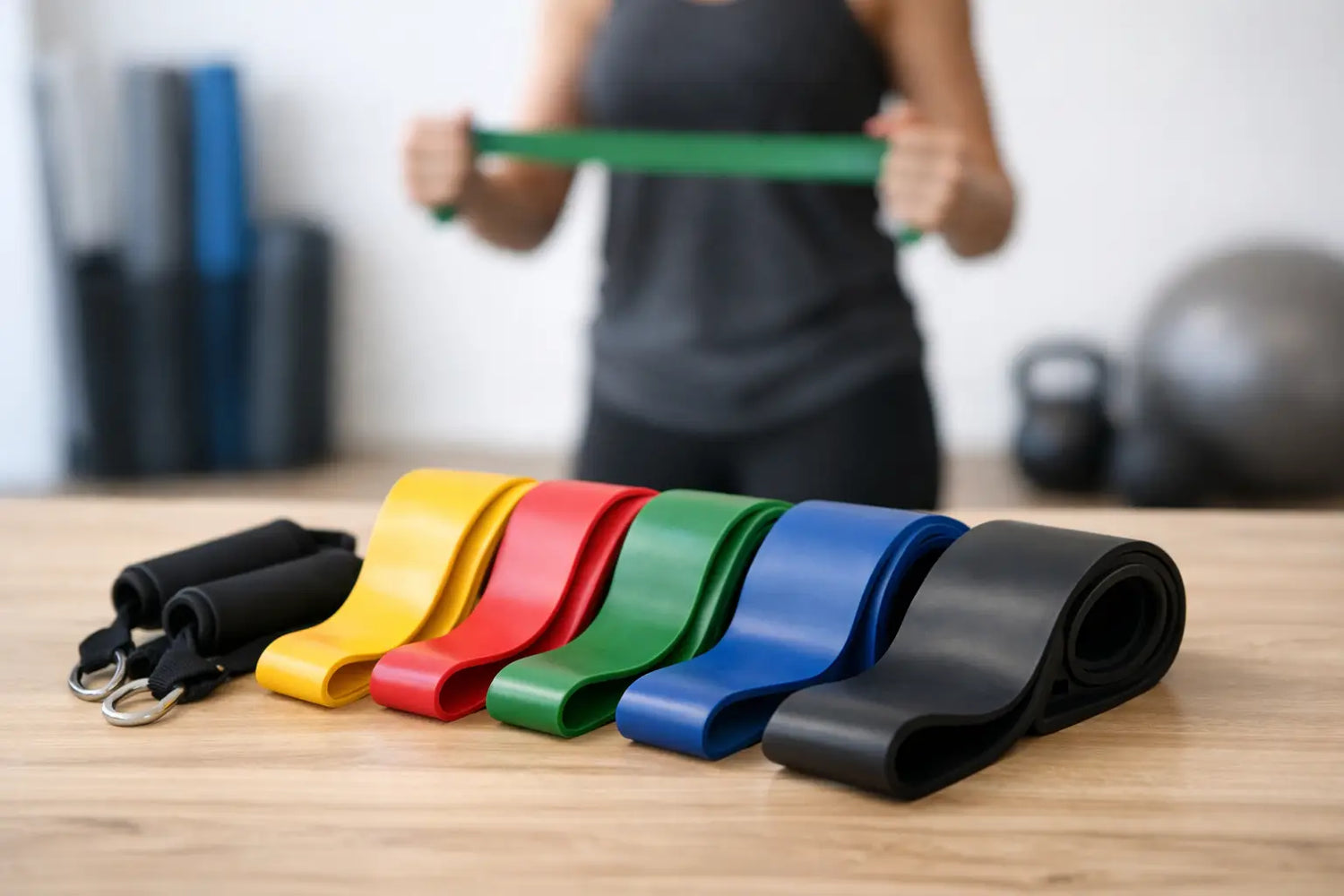
You do not need a giant rack of weights to get a solid workout. But you do need the right band tension, because a resistance band that is too light feels pointless, and one that is too heavy turns every rep into a wrestling match. If you are wondering how to choose resistance band levels, the answer starts with your goal, the exercise, and how the last few reps actually feel.
Why resistance band levels matter
Resistance bands look simple, but the level you choose changes everything. Too little resistance and you will cruise through a set without giving your muscles much reason to adapt. Too much resistance and your form usually falls apart first, which is where progress starts ghosting you.
The sweet spot is a band that makes the final reps challenging while still letting you move with control. That matters whether you are training glutes in your living room, adding tension to push-ups, warming up your shoulders, or trying to stay consistent with quick home workouts between work, errands, and whatever else your day throws at you.
How to choose resistance band levels for your goal
Start with the reason you are using the band in the first place. Not all resistance band levels are meant for the same job.
If your goal is mobility, activation, or rehab-style movement, lighter bands usually make more sense. You want enough tension to wake up the muscles and guide the movement, not so much that you start compensating. Shoulder warm-ups, lateral walks, glute activation, and joint-friendly recovery work often live in the light to medium range.
If your goal is muscle growth or strength endurance, medium to heavy bands are usually more useful. Squats, rows, chest presses, Romanian deadlifts, and banded hip thrusts need enough resistance to challenge larger muscle groups. A super-light band might work for 30 easy reps, but that is not the same as effective resistance.
If your goal is assisted bodyweight work, such as pull-ups or dips, the naming can feel backward. A thicker, heavier band provides more assistance because it helps lift more of your body weight. In that case, a heavier band is not harder. It is more supportive.
That is the first big rule: band level depends on what the band is doing in the exercise.
The problem with color labels
A lot of shoppers expect resistance band colors to work like traffic lights - one universal system, easy to follow, no drama. Unfortunately, brands do not always use the same color-to-resistance scale.
One company might label yellow as extra light and black as heavy. Another might use pink, purple, and green with entirely different resistance ranges. That means color alone is not enough. You need to check the actual resistance range in pounds or the product description for intended use.
This is especially important if you are buying bands online. The better move is to compare tension levels, not assume your old blue band matches a new blue one from somewhere else. Same color, completely different personality.
Match the band to the exercise, not just your fitness level
This is where a lot of people get stuck. They think, I am a beginner, so I need a light band. Sometimes yes. Sometimes absolutely not.
Your fitness level matters, but the exercise matters just as much. You might need a light band for shoulder external rotations and a heavy one for glute bridges in the same workout. Your shoulders are not your glutes, and your band choices should respect that.
For smaller muscle groups and isolation exercises, go lighter. Movements like tricep extensions, face pulls, rear delt work, and shoulder stability drills usually feel better with less tension and cleaner control.
For bigger compound movements, go heavier. Squats, rows, chest presses, deadlift patterns, and hip thrust variations often need more resistance to feel productive.
Mini loop bands and long tube or flat bands also behave differently. Mini bands are great for lower-body activation and short-range tension. Long bands are more versatile for full-body training, stretching, and anchor-based exercises. If you are building a home setup, having a few levels instead of one heroic band is usually the smarter play.
A simple way to test if the level is right
If you want the fast answer to how to choose resistance band levels, use the rep test.
Pick the exercise and aim for your usual rep range. For many people, that is around 8 to 15 reps for strength and muscle-focused work, or 15 to 20 reps for activation and endurance.
The right band should let you complete the set with good form, while making the last 2 to 4 reps feel tough. Not impossible. Not sloppy. Just challenging enough that you know the set counted.
If you finish and feel like you could casually do 10 more reps, the band is too light. If your range of motion gets cut in half, your posture collapses, or you have to yank your way through the movement, it is too heavy.
That balance is what you are looking for - enough resistance to create effort, enough control to keep the exercise honest.
When to size up or size down
Your band level should not stay fixed forever. As your strength improves, exercises that once felt demanding can start feeling way too easy.
Size up when you can hit all your reps cleanly and still have plenty left in the tank. Size up when the movement feels more like cardio than resistance training. Size up when you are no longer getting that solid end-of-set challenge.
Size down when your form breaks early, the band changes your movement path too much, or you avoid full range of motion just to survive the set. Also size down if you are training through fatigue, returning after time off, or working around a minor limitation where control matters more than ego. Your band does not care about your pride, and honestly, neither do your joints.
Buying a single band vs a set
If you are only getting one band, choose based on your most common exercises. For lower-body training, a medium to heavy option is often the better value. For upper-body training, mobility, or rehab-style movement, a light to medium option is more practical.
But if you want flexibility, a set is almost always the better buy. Different exercises need different levels, and your strength will not stay the same forever. A set also makes it easier to progress without replacing everything later.
That is why many home workout shoppers end up happiest with multiple levels instead of one mystery band that either barely resists or tries to end the session early. If you are creating a simple home gym setup, this is one of those upgrades that pays off fast.
Common mistakes when choosing resistance band levels
One mistake is choosing based only on the word beginner or advanced. Those labels are rough guides, not laws. A beginner doing banded squats might need more tension than an experienced lifter doing shoulder rehab.
Another mistake is ignoring band stretch. Resistance increases as the band stretches, so the same band can feel light at the start of a movement and much heavier near the end. That is normal, but it also means setup matters. Where you stand, how far you anchor, and how much pre-tension you create will all change the feel.
Another easy mistake is using a band that is too heavy for activation work. If your glute warm-up turns into a full-body struggle session, the band is probably overshooting the purpose.
And finally, people often underestimate how useful lighter bands are. Heavy bands get the hype, but lighter options often do the precision work that keeps your training balanced.
Best approach for most home workouts
For most people training at home, the smartest setup includes at least three levels: light, medium, and heavy. That covers warm-ups, upper-body work, lower-body strength, and gradual progression without overcomplicating your routine.
If you are brand new, start with a set rather than guessing one level. If you already know you want glute-focused workouts, make sure your set includes enough resistance for lower-body movements. If your priority is mobility, posture, and lighter strength work, make sure the lighter levels are actually useful and not just filler.
The goal is not to own the most bands. It is to have the right tension ready when you need it, so workouts feel effective, fast, and easy to stick with. That is the kind of home fitness upgrade that earns its spot.
Choosing the right resistance band level is really about making your workouts feel challenging in the right way. When the tension matches the movement, everything clicks better - your form, your progress, and your motivation to keep going tomorrow.





Commenta
Questo sito è protetto da hCaptcha e applica le Norme sulla privacy e i Termini di servizio di hCaptcha.