
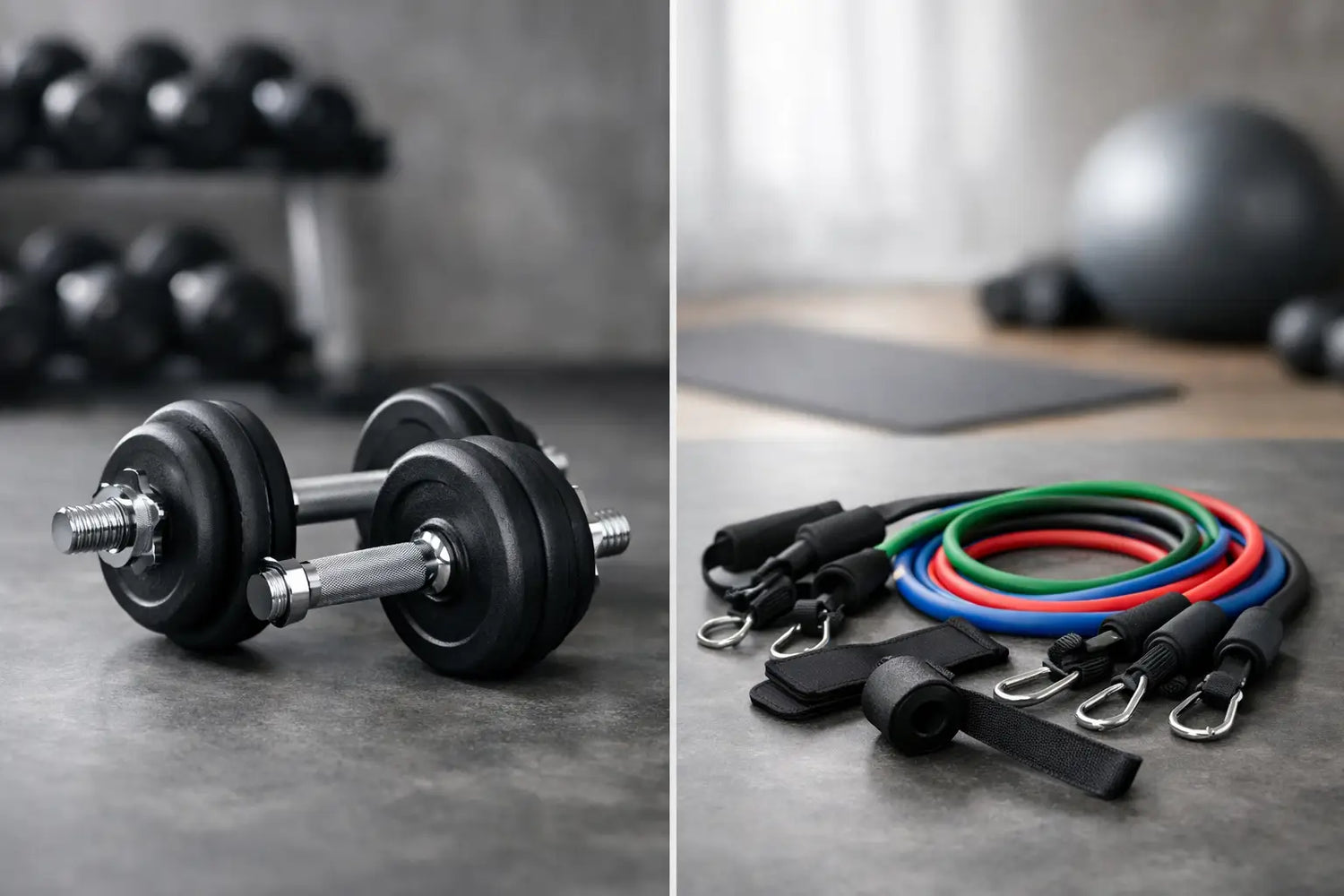
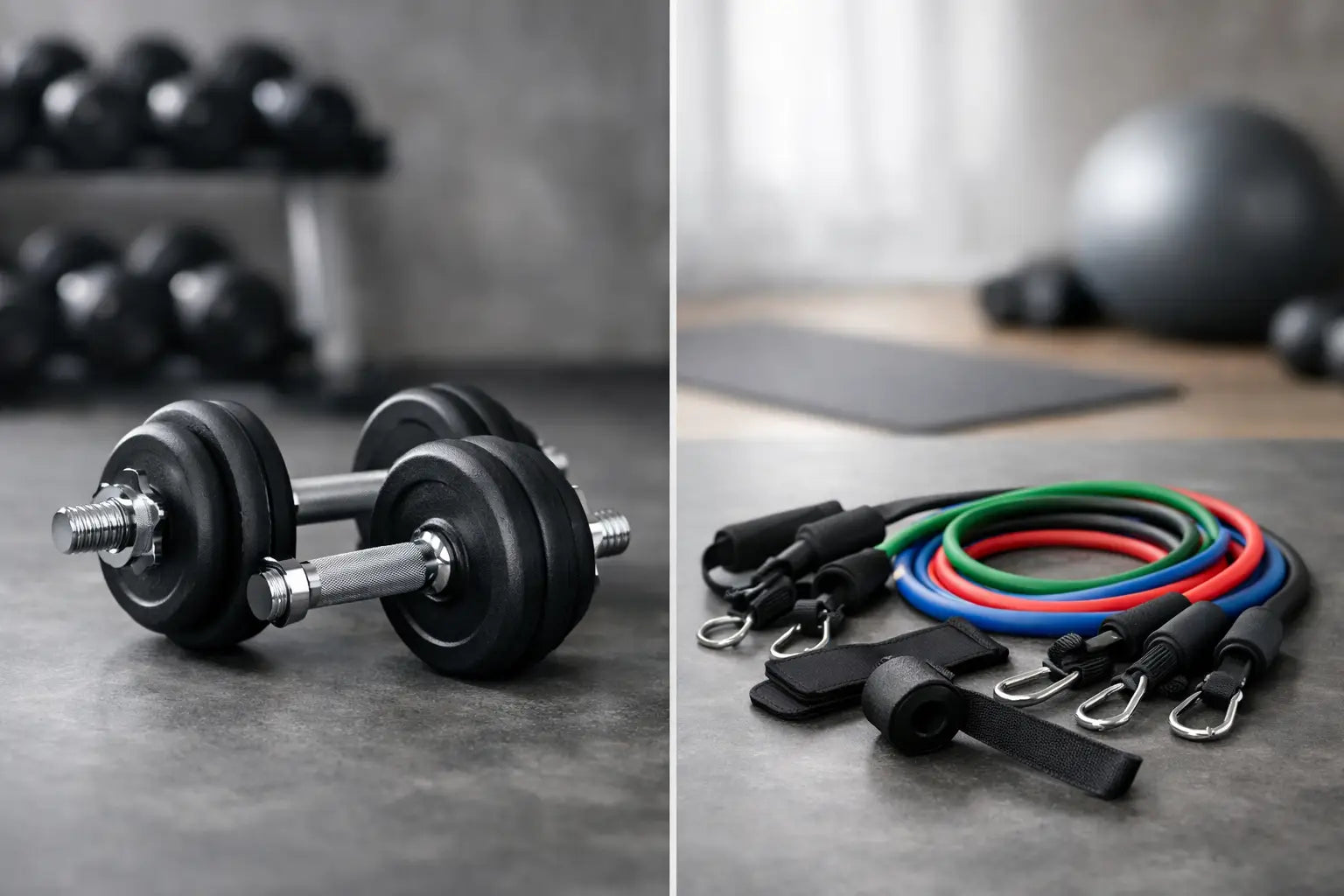
Your workout corner does not need to look like a crowded commercial gym to deliver real results. The question is whether dumbbells or resistance bands will make you excited to train on a busy Tuesday, in a small apartment, or between gaming sessions. Both can build strength, support muscle growth, and turn unused floor space into a seriously useful setup.
The better choice is not about which tool looks more hardcore. It is about your goals, your space, your budget, and the kind of workouts you will actually repeat. Here is how to pick your new home-gym MVP.
Dumbbells or resistance bands: the fast answer
Choose dumbbells when you want a familiar, measurable way to get stronger and lift heavier over time. Choose resistance bands when you need portable gear, more exercise variety in a tight space, or a lower-impact way to train. If you want the most flexible home setup, a pair of adjustable dumbbells plus a band set is a power combo without turning your bedroom into a weight room.
There is one catch: equipment only works when it gets used. A fancy setup that lives under the couch is just expensive furniture with great intentions.
Why dumbbells still earn their spot
Dumbbells are simple in the best way. You pick them up, move them with control, and add weight as you become stronger. They are ideal for exercises such as presses, rows, squats, lunges, deadlifts, curls, and overhead work. Because the load stays consistent throughout most of the movement, dumbbells make it easy to track progress.
They make progressive overload clear
Progressive overload means gradually asking your muscles to do more. With dumbbells, that may mean going from 10 pounds to 15 pounds, adding reps, slowing the lowering phase, or completing an extra set. Seeing those numbers move up can be wildly motivating. One day, the weight that used to feel impossible becomes your warm-up. That is a pretty satisfying plot twist.
Dumbbells also challenge stabilizer muscles because each arm or leg works independently. A dumbbell bench press, for example, can reveal that one side is doing a little more than its fair share. Training each side separately helps build balanced strength and body awareness.
The trade-offs: cost, storage, and impact
Dumbbells take up more room than bands and can get expensive as you add heavier weights. Fixed-weight sets are straightforward, but adjustable dumbbells can be a smarter move for small spaces. They give you multiple weight options without a whole rack claiming your living room.
They can also feel less friendly for total beginners or anyone managing joint discomfort. Good form matters, especially on moves like overhead presses, hinges, and squats. Start lighter than your ego suggests, learn the movement, and build from there.
Where resistance bands shine
Resistance bands are compact, versatile, and surprisingly challenging. A full set can fit in a drawer, backpack, or suitcase, which makes bands a great option for apartment workouts, travel, and anyone who wants a no-excuses training tool nearby.
Loop bands, tube bands with handles, and long resistance bands each offer different possibilities. You can use them for glute work, rows, presses, pull-aparts, assisted pull-ups, mobility drills, and warm-ups. They are also handy for making bodyweight exercises harder without needing more floor space.
Bands create a different kind of resistance
Unlike dumbbells, bands become more resistant as they stretch. That means the hardest part of many exercises happens near the end of the range of motion. On a banded squat, row, or chest press, you may feel the tension really kick in at the top of the movement.
This can be useful for muscle-building workouts, especially when you work close to fatigue with controlled reps. Bands also tend to be gentler on joints because they do not rely on heavy external weight or momentum. For recovery days, mobility sessions, and lower-impact training, they bring a lot to the party.
The trade-offs: measuring progress is trickier
Bands are not perfect. Resistance can vary between brands, and it is harder to know exactly how much load you are using. A thicker band may feel very different depending on how far it is stretched, where you stand, and how it is anchored.
That does not make progress impossible. Track your band color or level, reps, sets, stretch length, and control. Still, if your main goal is to lift progressively heavier for years, dumbbells offer a clearer path. Bands also need regular checks for cracks, thinning material, or damaged handles. A worn band snapping mid-rep is not the kind of workout surprise anyone ordered.
Which one is better for your fitness goal?
For general strength and visible muscle development, dumbbells have a slight edge because loading is easier to increase and heavy compound movements are more practical. That said, resistance bands can absolutely build muscle when your sets are challenging and your technique is solid. The best results come from consistency, enough training volume, recovery, and food that supports your goals, not from picking the most dramatic-looking piece of gear.
For fat-loss workouts, either tool works. Strength training helps preserve muscle while you improve your nutrition and activity habits, but neither dumbbells nor bands magically target fat in one area. Choose the equipment that lets you train regularly, move with confidence, and enjoy the process.
For mobility, rehab-style movement, and beginner-friendly sessions, bands often win. They let you use light resistance and adjust angles easily. If you have an injury, persistent pain, or a medical condition, get personalized guidance from a qualified health professional before starting a new routine.
Pick your gear based on real life
Choose dumbbells if you want numbers to chase
Dumbbells are a strong fit if you like structure and measurable wins. You want to know what you lifted last week, add a little more next month, and feel stronger in everyday tasks like carrying groceries or hauling a suitcase. Adjustable dumbbells are especially practical when space is limited but your ambition is not.
Choose resistance bands if space is your biggest issue
If your workout area is a corner of your bedroom, bands are hard to beat. They store fast, travel easily, and can create a full-body session without rearranging half the room. They are also a smart first purchase if you are testing whether home workouts fit your routine.
Choose bands if you need variety without bulk
Bands can change the angle and feel of familiar exercises quickly. You can add them to squats, push-ups, glute bridges, and rows, then use lighter bands for shoulder activation or stretching. That variety makes them great for people who get bored doing the same routine on repeat.
Choose both if you want the most options
This is the move for many home exercisers. Use dumbbells for heavier lower-body work, presses, rows, and carries. Use bands for warm-ups, glute activation, mobility, high-rep finishers, and exercises that are awkward to load with weights. You do not need a giant collection - a few well-chosen pieces can cover a lot of ground.
How to build a compact home workout setup
Start with the training you can picture yourself doing three times a week. If that means a pair of dumbbells and a small open area, great. If it means bands you can pull out while your coffee brews, also great. Convenience is a feature, not a compromise.
A practical starter setup might include adjustable dumbbells or two to three pairs of fixed weights, a set of loop or tube bands, and a comfortable exercise mat. If you are shopping for home gym gear at Timo Market, think beyond the product photo: check the resistance levels or weight range, storage needs, grip comfort, and whether the equipment fits your current fitness level.
Keep your gear visible enough to invite action, but organized enough that it does not become clutter. A basket for bands, a designated corner for weights, and a simple plan on your phone can make starting feel almost automatic.
Make either option work harder
With dumbbells, focus on controlled reps and full range of motion. Avoid swinging through curls or rushing presses just to finish faster. With bands, use a secure anchor point, maintain tension, and move slowly enough to feel the resistance through the entire exercise.
For either tool, begin with two or three full-body sessions each week. Include a squat or lunge, a hinge, a push, a pull, and a core movement. Train hard enough that the final few reps feel challenging while your form stays clean. Then give yourself time to recover and come back stronger.
The right choice is the one that makes movement easier to start and more fun to repeat. Pick the gear that fits your space, grab it when you have 20 minutes, and let those small sessions become the upgrade your routine has been waiting for.

Leave a comment
This site is protected by hCaptcha and the hCaptcha Privacy Policy and Terms of Service apply.